What Is a Liquidity Pool and Why Active Management Matters

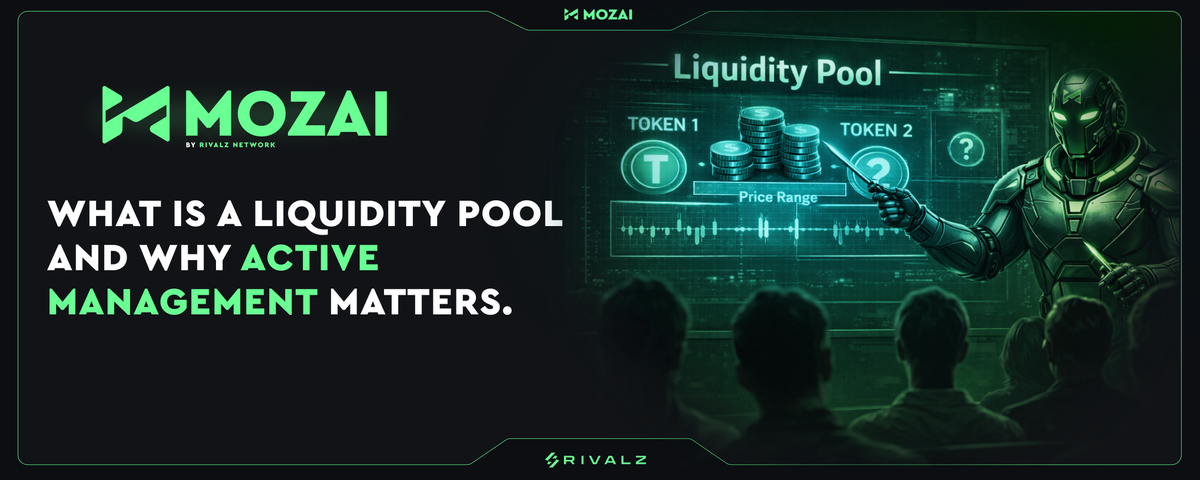
Liquidity pools are one of the core building blocks of DeFi.
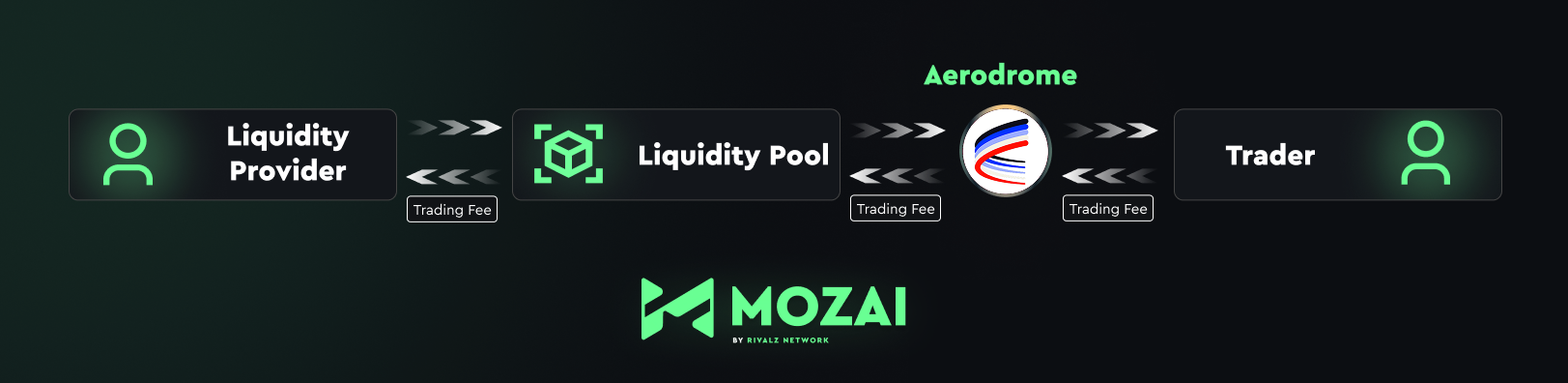
They allow users to provide assets to a decentralized exchange so others can trade between them. In return, liquidity providers may earn a share of the fees generated by activity in that pool.
At first, the idea sounds simple. Deposit assets, provide liquidity and earn fees.
In practice, it is more complex than that.
Modern liquidity pools, especially concentrated liquidity pools, can be efficient, but they also require positioning, monitoring, rebalancing and ongoing adjustments if they are meant to stay productive over time.
That is exactly where active management becomes important.
And it is also where MOZAI’s AI-Managed LP Agent changes the experience.
What is a liquidity pool?
A liquidity pool is a smart contract that holds two assets together so users can trade between them on a decentralized exchange.
Instead of relying on buyers and sellers to match directly, a pool provides the liquidity needed for swaps to happen instantly.
For example, a pool might contain two assets such as USDC and msUSD, USDT and USDC or any other supported pair.
When you participate in that pool, you are contributing assets so traders can swap one token for the other. In return, the position may earn a portion of the trading fees generated by the pool.
That is the foundation of liquidity provision.
How does a liquidity pool work?
Most liquidity pools are built around a pair of assets.
To provide liquidity, those two assets need to be deposited into the pool in the structure required by the exchange.
Once deposited, that position becomes part of the liquidity available for traders.
Every time users trade through that pool, fees may be generated. Liquidity providers may receive part of those fees depending on how the pool works, how much liquidity they provide and how active their position is.
The key point is that a liquidity pool is not just about depositing tokens. It is about making those assets available in a way that allows trading to happen efficiently.
What makes concentrated liquidity different?
On platforms like Aerodrome, liquidity is often not spread across every possible price. Instead, it can be placed inside a specific price range.
This is called concentrated liquidity.
Rather than distributing capital everywhere, concentrated liquidity focuses it around the market levels where trading is more likely to happen.
That can make capital more efficient and improve the potential to generate fees.
But there is an important condition.
The liquidity mainly works while the market price stays inside the selected range. If the market moves outside that range, the position may become less effective and may stop earning fees in the same way. This is why concentrated liquidity can be powerful, but also demanding.
It needs active management.
Why manual LP management is difficult.
Managing a concentrated liquidity position manually is not just a one-time action.
It usually means watching the market, understanding where the active range sits, deciding when to remove and redeploy liquidity and potentially rebalancing the token mix along the way.
That creates a few obvious challenges.
- It takes time. Market conditions change and a position that makes sense today may not remain optimal tomorrow.
- It requires understanding how concentrated liquidity behaves. Users need to think about price ranges, token ratios, pool mechanics and when repositioning may be necessary.
- Delays matter. If the market moves and a position is not adjusted in time, liquidity may sit outside its active band and become less productive.
In simple terms, manual LP management is possible, but it can be slow, operationally heavy and inefficient for many users.
What MOZAI changes
MOZAI is designed to make that process easier.
Instead of asking members to handle every step themselves, MOZAI uses an AI-Managed LP Agent to automate the operational side of liquidity provision.
The goal is straightforward.
Keep the liquidity position active, aligned with market conditions and easier to manage over time.
That means the Agent can help with the setup, monitor the position and take action when conditions change.
A simpler way to enter an LP position
On MOZAI, the member only deposits one supported token.
From there, the Agent calculates what is needed for the LP position, performs the necessary trade to obtain the second token and prepares the two-sided allocation required for the pool.
This makes the experience much simpler for the user.
MOZAI is not only helping manage the position after deposit. It is also reducing the friction before the liquidity is even deployed.
What the AI-Managed LP Agent does
Once the position is prepared, the Agent helps manage it on Aerodrome.
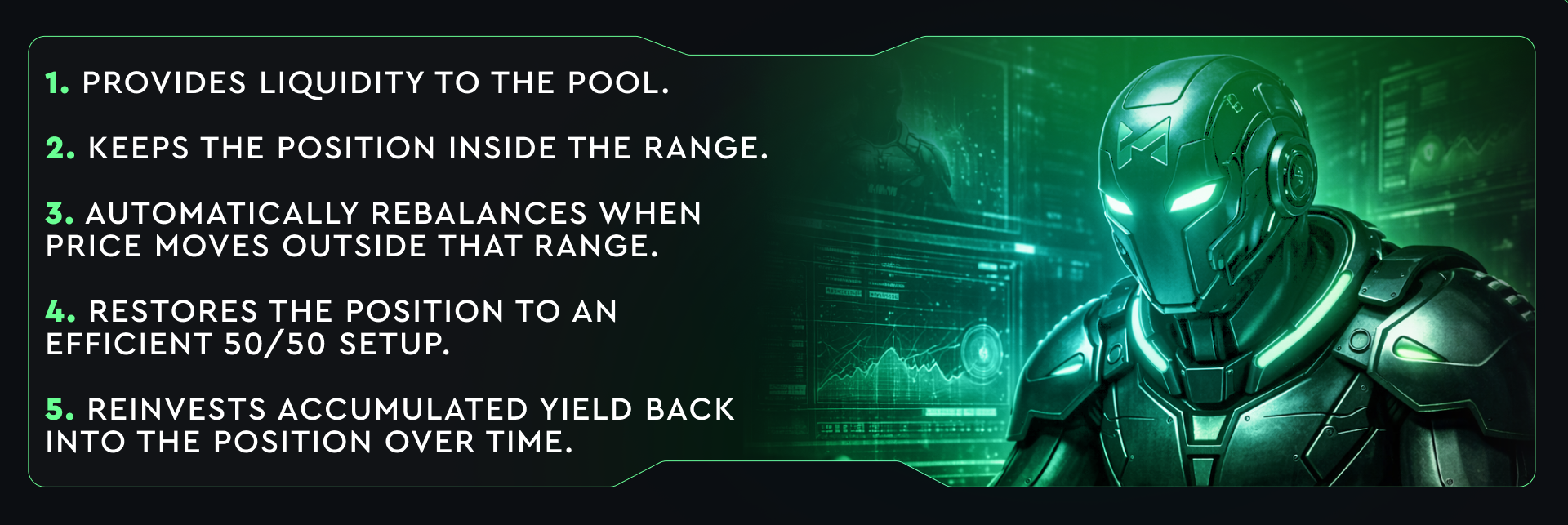
At a high level, the Agent is designed to keep the position working in the market rather than leaving it static.
That can include:
- Monitor the current market price
- Check whether the position is still inside its active range
- Adjust the asset mix when needed
- Redeploy liquidity around a new market level if the previous range is no longer ideal.
In practice, that means the Agent is handling the operational work that many users would otherwise need to do manually.
This creates a smoother user experience, a more consistent process and easier access to concentrated liquidity strategies without forcing every user to become a full-time LP operator.
In short, it is the same liquidity product with smarter management.
Important to understand
Fees still exist
While MOZAI simplifies the process, liquidity provision still involves onchain actions and those actions can come with costs.
This is especially important to understand when the Agent is converting part of the initial deposit into the second token needed for the pair.
That setup step can involve swap-related fees.
Later, if the strategy needs to rebalance, reposition or redeploy liquidity, there may also be additional execution costs depending on the action being taken.
So while MOZAI removes manual complexity, it does not remove the reality that LP strategies can involve fees.
That is an essential part of using any onchain liquidity product.
A simpler user experience does not mean a cost-free process.
Risks still matter
Automation improves management, but it does not eliminate risk.
Liquidity provision still comes with the same underlying DeFi considerations, including market risk, smart contract risk, protocol risk, asset-specific risk and the possibility of impermanent loss depending on the pair.
For more stable or closely related pairs, some risks may be lower than in highly volatile markets, but they are not zero.
That is why understanding the product remains important, even when the operational side becomes easier.
In resume
A liquidity pool allows users to provide two assets so others can trade between them, while potentially earning fees in return.
On Aerodrome, concentrated liquidity can make that strategy more efficient, but it also requires active management to remain effective.
That is the gap MOZAI is built to solve.
Instead of asking the member to prepare both assets, monitor the range and manage every adjustment manually, MOZAI allows the member to deposit one supported token while the Agent handles the setup, conversion and operational management needed for the LP position.
That does not remove fees and it does not remove risk.
It does make the process more practical, more accessible and easier to manage over time.
That is the real value of AI-Managed LPs on MOZAI.
Same LP product. Smarter management.